
Cedar Tone · Updated September 20, 2026 · Interior painting
Eco-Friendly Paint Options for Your Home: Low-VOC and Zero-VOC Explained
In short: For most interior work, a low-VOC or zero-VOC waterborne paint is the eco-friendly option, and it is now the standard rather than a specialty product. It matters most in bedrooms, nurseries and any winter job when the windows stay shut. Outside and on cabinets, the sustainable choice is the coating that lasts longest, because the paint you do not have to reapply is the greenest paint there is.
The short answer: For most interior work, a low-VOC or zero-VOC waterborne paint is the eco-friendly option, and it is now the standard rather than a specialty product. It matters most in bedrooms, nurseries and any winter job when the windows stay shut. Outside and on cabinets, the sustainable choice is the coating that lasts longest, because the paint you do not have to reapply is the greenest paint there is.
Here is how we think about it at the kitchen table, without brand names and without claims we cannot back.
What VOC means, and what the label does not tell you
VOCs are volatile organic compounds: the solvents in a coating that evaporate into the air as it dries. They are most of what you smell in a freshly painted room, and they are what regulators limit. Low-VOC means the paint falls under a set number of grams per liter. Zero-VOC means the base measures at or near none.
Two things the can does not say. First, both terms describe the untinted base. Colorant can add VOCs, and a deep, saturated color may add enough to move a zero-VOC base into low-VOC territory. If the number matters to you, ask for the technical data sheet on the tinted product. Second, VOC content is a rule about outdoor air quality, not a full picture of indoor safety. A paint can be low in VOCs and still contain things you would rather not breathe. The certifications below exist to fill that gap.
The practical news is that low-VOC and zero-VOC waterborne paints are now the default for interior walls and ceilings. They cover, scrub and touch up as well as the solvent-heavy products they replaced. Choosing them costs you nothing in performance on a wall.
Green Seal and the other marks
We hold a Green Seal Certification, and we are a Certified Green Building Professional, as our site states. Green Seal is an independent standard that looks at a product’s full ingredient list and performance, not only its VOC number. Other third-party marks test emissions from the cured film in a chamber. Any of them tells you more than the words “eco” or “natural” on the front of a can, which are marketing.
What a certification does not do is make prep or application better. A certified paint on chalky siding or greasy cabinet doors fails the same way any paint does. The mark is a starting point for choosing the product, and the rest of the job is still the rest of the job.
Where low-VOC matters most
The rooms where it matters are the rooms where people spend the night and the seasons when the windows stay shut.
Bedrooms and nurseries. A nursery is the room we get asked about most, and it is the easy call: zero-VOC base, a light color so the tint adds little, and paint it a few days before it is needed. Bedrooms are the same logic.
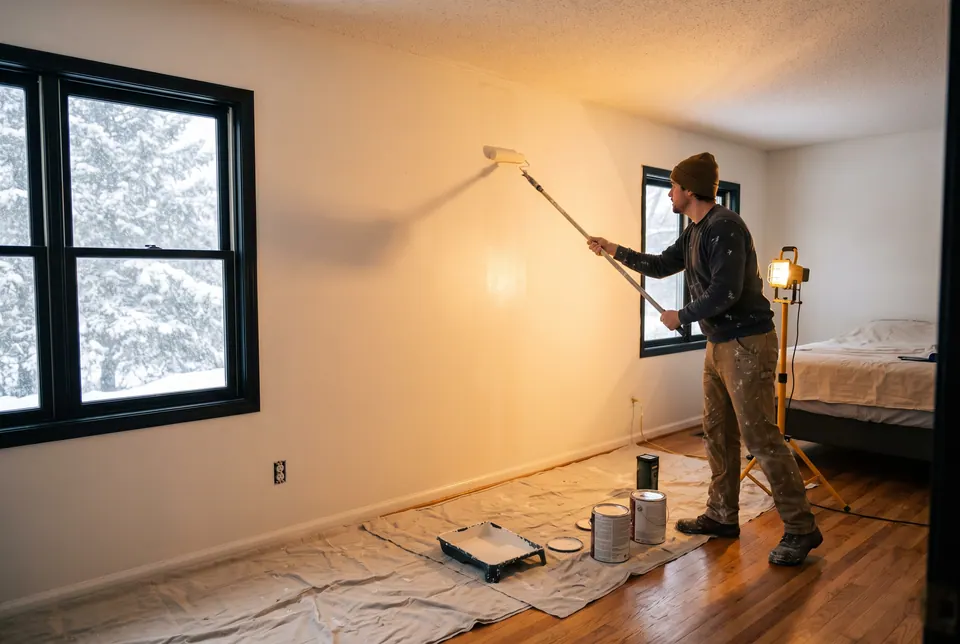
Winter interior work. This is the Minnesota-specific part. Interior painting is what our crew does from November through April, when exteriors are shut down, and a house in January is sealed tight. Newer construction in the outer ring, including a lot of Otsego and Albertville, is built tight enough that an open interior door is the only air movement in the house once the furnace fan cycles off. Low-VOC products stop being a preference in that setting and become the only sensible choice.
Anyone with asthma or chemical sensitivity. Tell us at the estimate. We can schedule the work so the affected rooms are painted first and have the longest airing time, and we can bring the data sheets.
Ventilation is still part of the job
Low-VOC does not mean no smell and it does not mean no moisture. Waterborne paint gives off water as it dries, and in a closed house in winter that water goes into the air and onto the coldest windows.
Our habits on a winter interior job: crack a window in the room being painted, even at ten below, and set a box fan in it blowing out. Run the furnace fan on continuous so the air moves through the whole house instead of pooling in one room. Leave interior doors open. Paint bedrooms in the morning so they have all day to air before anyone sleeps in them. Do the trim enamel, which off-gasses longer, last in the day and in a room that can be closed off.
Cold also slows drying. A second coat that would go on in two hours in July might need four in January, and we build that into the day rather than rushing it.
Outside, durability is the green choice
Exterior paint is where the eco conversation flips. Low-VOC exterior products exist and we use them, but the biggest environmental variable on an exterior is how many times the house has to be painted over its life.
A repaint that lasts a decade uses half the paint, half the trips and half the masking plastic of two that last five years each. The things that make a coat last are prep and application: washing off the chalk, replacing rotten wood instead of painting over it, priming bare spots, and spraying siding with a back-brush behind it so the paint is worked into the grain instead of sitting on top. None of that shows on a can label. All of it is in how our exterior painting jobs are run, and it is why we would rather sell you a job that lasts than a product with a leaf on the can.
Cabinets and trim: the honest trade-off
Cabinet and trim enamel is where we make a small compromise on the VOC number. A wall paint on a cabinet door stays soft for months and fingerprints. A waterborne enamel cures hard, and the products that do that well carry a low, not zero, VOC number.
Our answer is to keep the fumes out of your kitchen. On a cabinet painting job we pull the doors and drawer fronts and spray them off site in a booth, where the ventilation is built for it. Only the boxes get sprayed in the house, with the kitchen masked off and a fan pulling air out. You get the hard finish, and the bulk of the off-gassing happens in our shop instead of your home.
Waste, leftovers and disposal
The part of eco-friendly painting that gets skipped is what happens to the paint you do not use.
We buy to the job, not to the truck. When we finish, we leave you a labeled quart of each color for touch-ups and take the rest with us. If you have old cans in the garage, dry out small amounts of latex with the lid off or a handful of cat litter, and put the hardened can in the trash. Larger amounts and anything solvent-based go to the county household hazardous waste drop-off; both Wright and Hennepin counties run one. Nothing goes down a drain or on the ground. Empty metal cans can be recycled once they are dry.
What we’d tell you at the estimate
For interior walls and ceilings, ask for a zero-VOC base and keep the tint light in the rooms where you sleep. For trim and cabinets, accept a low-VOC waterborne enamel that cures hard, and let us spray the doors in the booth. For the exterior, put your money in prep and rot repair, because the coat that lasts is the one that uses the least paint.
If you want to talk through products for a specific room, or you have someone in the house who reacts to paint, mention it when you reach us through the contact page and we’ll plan the job around it.
Want us to look at your house?
Text a few photos and tell us what you are after. We reply with a written estimate.
Related questionsStraight answers.
What does low-VOC paint mean?
VOCs are volatile organic compounds, the solvents that evaporate as paint dries and cause most of the smell. Low-VOC means the base paint falls under a set limit per liter; zero-VOC means the base measures at or near none. Both refer to the untinted base. Deep colors can add VOCs through the colorant, so ask about the tinted product, not the can label.
Is zero-VOC paint as durable as regular paint?
For interior walls and ceilings, yes. The waterborne products we use on walls are low-VOC or zero-VOC and they scrub, cover and touch up as well as anything we have used. Where the trade-off shows is in hard-wearing enamels for cabinets and trim, where we choose a waterborne enamel that cures hard and accept a low, not zero, VOC number.
How long should I wait to sleep in a room after painting it?
With a low-VOC or zero-VOC wall paint and reasonable ventilation, the same night is usually fine once the walls are dry to the touch, which is a few hours. With an enamel on trim or doors, give it a day. In winter we crack a window and run the furnace fan, and we paint bedrooms first in the day so they have the longest airing time.
Does Cedar Tone use eco-friendly paint?
Our standard interior wall products are low-VOC or zero-VOC waterborne paints, and we hold a Green Seal Certification, as stated on our site along with Certified Green Building Professional. We do not name brands. What we can tell you at the estimate is the VOC content of the exact tinted product going on your walls, and we are glad to.
What do I do with leftover paint in Wright or Hennepin County?
Keep a labeled quart for touch-ups. Dry out small amounts of latex with the lid off or with cat litter and put the hardened can in the trash. Larger amounts and anything solvent-based go to the county household hazardous waste drop-off. Never pour it down a drain or into the yard; both counties treat liquid paint as hazardous waste.