
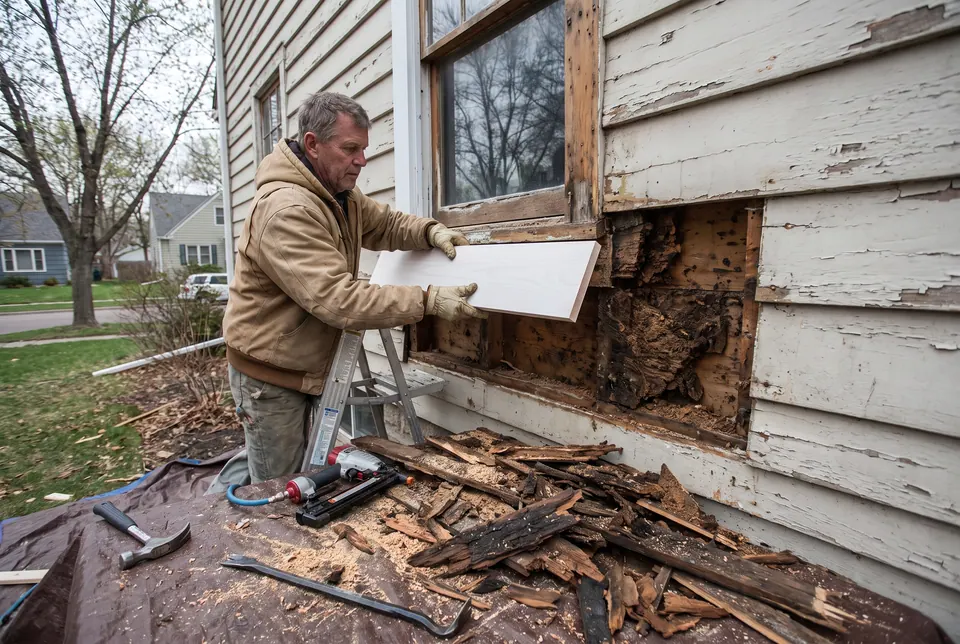
Where rot starts on a northwest metro house
Water runs downhill and sits at the bottom of things, so that is where the wood goes first. On the houses we work on between Rockford, Buffalo, Maple Grove and Plymouth, the same handful of spots come up again and again. Window sills and the bottom few inches of the casings on the north and east sides, where snow piles against them and the sun never dries them out. Corner boards where the end grain sits an inch off the ground or touches a deck. Fascia behind a gutter that has been overflowing or backing up under an ice dam. Soffit panels at the low corners of the roof, especially over a garage. Door jambs and brickmold at a front stoop that gets shoveled all winter. And on decks, the board ends at the stair stringers and the base of the railing posts. Most of it is hardboard or finger-jointed pine trim from the 1980s through the 2000s, which soaks up water at any cut end that was never sealed.
- Window sills and the bottom of casings, north and east exposures
- Corner boards and trim that sit close to grade or a deck
- Fascia behind clogged or overflowing gutters
- Soffit panels at low corners and over garages
- Door jambs and brickmold at shoveled stoops
- Deck boards, stair stringers and railing post bases
Why caulking over rot fails in two winters
The tempting shortcut is to fill the soft spot, caulk the seam, prime it and paint it. It looks fine the day the crew leaves. Then the first Minnesota freeze arrives. Rotten wood holds water like a sponge, and the caulk and paint seal that water in instead of out. It freezes, expands, and pushes the filler loose from behind. By the second spring the paint has lifted in a sheet, the seam has opened back up, and the rot has spread another few inches into wood that was sound when the job was done. Punky wood also cannot hold a nail or a screw, so a caulked repair on a corner board or a fascia has nothing to fasten to. That is why we treat rot as a carpentry problem first. We cut back to solid wood, replace the piece, seal the cut ends and then paint it. It costs more than a tube of caulk on the day. It costs less than doing the same wall twice.
How we find it: an awl at the walkthrough
Rot hides under a skin of paint that can look intact from the driveway, so we do not estimate exteriors from the driveway. At the walkthrough one of us carries an awl and works around the house at the spots listed above, pressing the point into the wood. Sound wood stops it. Rot lets it sink in with almost no effort, and we mark the board with tape. We also tap along fascia and look for the telltale signs: paint that has lifted in a blister with dark wood under it, a seam that has gone black, a sill that has cupped or a casing that has pulled away from the siding. Everything we find goes on the written estimate as its own line item with a length and a material, so you can see what is being replaced and what the paint job would cost without it. Sometimes we find more once the old board is off. When that happens we show you before we go any further.
Primed replacement stock, then paint
We replace trim with material that is primed on all sides before it goes up, and we seal every cut end on site. Bare end grain is how the original board took on water, and there is no point repeating it. For fascia and corner boards that means primed finger-jointed or engineered trim in the same profile as what came off. For sills and casings it is often solid wood or a composite where the sill takes the most weather. Rotten deck boards and railing sections get swapped for treated or cedar stock to match the deck. Once the carpentry is done the new pieces get caulked at the joints, spot primed at any nail holes and painted with the rest of the house, so the repair disappears into the finish coat instead of reading as a patch. This page exists as a spoke of our exterior painting service for a reason. Margaret L. described it well in her review of her old wooden house: good judgement on the siding repairs, then the painting, and it looked like a new house when it was done.
When we would talk you out of it
- A whole wall where the sheathing behind the siding is soft, not only the trim. That is a siding and sheathing job, and we would move you to our siding page and walk the wall together before quoting.
- A deck where the joists, beam or ledger are rotten, not only the boards. Swapping deck boards onto a bad frame wastes money. See our deck rebuild page instead.
- A window where the sash and frame have rotted through, not only the exterior casing. At that point a new window is the repair, and we can install it under our contractor license.
What you get
- Every exterior estimate includes an awl probe of sills, casings, fascia, soffit and corner boards
- Repairs listed as separate line items with lengths and materials, so you see the carpentry cost apart from the paint
- Replacement stock primed on all sides with cut ends sealed on site
- Profiles matched to the existing trim so the new board reads as original
- Carpentry and painting by one company under one license, one schedule and one walkthrough
- Fascia and soffit repairs coordinated with gutter and roof-edge work when both are needed
How it goes
Walkthrough with an awl
We go around the house pressing at the usual spots and tap along the fascia. Soft wood gets taped and photographed so you can see what we found.
Written estimate with repairs itemized
Each board goes on the estimate as its own line with a length and a material, next to the painting scope. You approve the carpentry you want done.
Cut out, replace, seal
We remove the rotten piece back to solid wood, fit primed replacement stock in the same profile, seal every cut end and fasten it properly.
Caulk, prime, paint, walk it with you
Joints get caulked, nail holes filled and spot primed, then the new trim is painted with the rest of the house. We walk the exterior with you before we leave.
What does rot and trim repair cost in the northwest metro?
Trim repair is priced by the piece, so the estimate depends on how many boards are soft, how long each run is and how hard they are to reach. A single cupped sill on a first-floor window is a small line item. Forty feet of fascia at the peak of a two-story house, with the gutter coming down and going back up, is a different day. Material matters less than people expect, but a wide cedar corner board costs more than a strip of primed pine. The biggest swing is what we find once the old board is off. If the sheathing behind it is sound, the repair stays small. If water has gotten behind the housewrap, the scope grows and we stop and show you before it does. Because we are already on site to paint, the carpentry rides on the same setup, which keeps the added cost lower than bringing in a separate contractor.
- Number of boards that are soft and the length of each run
- Height and access, including work at a two-story fascia or over a roof
- Trim material and profile being matched
- Whether the gutter, downspout or a light fixture has to come off and go back
- Condition of the sheathing and housewrap behind the trim
- Whether the repair is part of a full exterior paint job or a standalone visit
From the reviewsWhat customers say about this work
★★★★★We have an old wooden house and they used good judgement and did a great job on the repairs they did on the siding as well as the actual painting. When they were done, it looked like a new house! They were responsive to our requests, were polite and unobstrusive on the job and we are very satisfied with the work they did.
★★★★★I hired Cedar Tone Painting to paint the white exterior trim on my home, I was a little nervous to have the house trim painted, as I just had my brown roof finished. The guys showed up when they said they would, the guys were polite, quiet and very professional and did not spill one drop of white paint on my new brown roof...I am super impressed. I also had them replace some rotten boards on the exterior of my home that turned out fantastic. I will definitely hire Cedar Tone Painting again!
Questions we get on the phoneStraight answers.
Can you just paint over rotten wood?
No, and we will not do it. Paint needs solid wood to grip, and rotten wood holds water that freezes and pushes the new paint off within a winter or two. We cut the rot out, replace the board with primed stock and then paint it, which is the only repair that lasts. If a painter offers to fill and paint a soft sill or fascia, the surface may look fine on the day. Expect the paint to lift and the seam to open the second spring, with the rot a few inches further along than it was.
How do you know if the wood is rotten under the paint?
We press an awl into the wood at the spots where rot usually starts: sills, the bottom of casings, corner boards near grade, fascia behind gutters and soffit at low corners. Sound wood stops the point. Rot lets it sink in. Anything soft gets taped, photographed and put on the estimate. Other clues are paint blistered with dark wood underneath, black seams, cupped sills and casings pulling away from the siding. We do this on every exterior estimate, not only when a homeowner asks about rot.
Do I need a licensed contractor to replace trim and fascia?
For a few pieces of trim on your own house, Minnesota does not require it. For work you hire out, a residential building contractor license is what lets a company legally do exterior carpentry beyond paint. Ours is BC807049. It means the same crew can replace the board and paint it under one license and one estimate. Practically, it also means the repair is done by people who fit trim for a living, with the ends sealed and the profile matched, instead of a painter improvising with a saw.
Will the new trim match the old trim?
Yes, in profile and in finish. We match the width, thickness and edge profile of the existing trim so the replacement lines up with the boards on either side of it. Once it is caulked, primed and painted with the rest of the house, the repair disappears into the finish coat. Stained cedar trim is the one exception. New cedar takes stain a little differently than wood that has weathered for twenty years, so we blend the color on a sample first and, where needed, restain the run so it reads as one piece.
Can you replace rotten deck boards and railings too?
Yes. Deck boards, stair treads, stringers and railing sections are part of what our contractor license covers, and we replace them before staining a deck for the same reason we replace trim before painting a house. Lynn M. mentioned in her Google review that we coordinated rebuilding stairs that were unsafe for her grandchildren. If the frame under the deck is sound, board and railing repair is a good fix. If the joists or ledger are soft, we would talk about a rebuild instead.
Related
Where we do this work
Rot and trim repair from our shop in Rockford across Greenfield, Delano, Corcoran, Buffalo, Medina, Rogers, St. Michael and Albertville, and the rest of the northwest metro. See the full service area.