
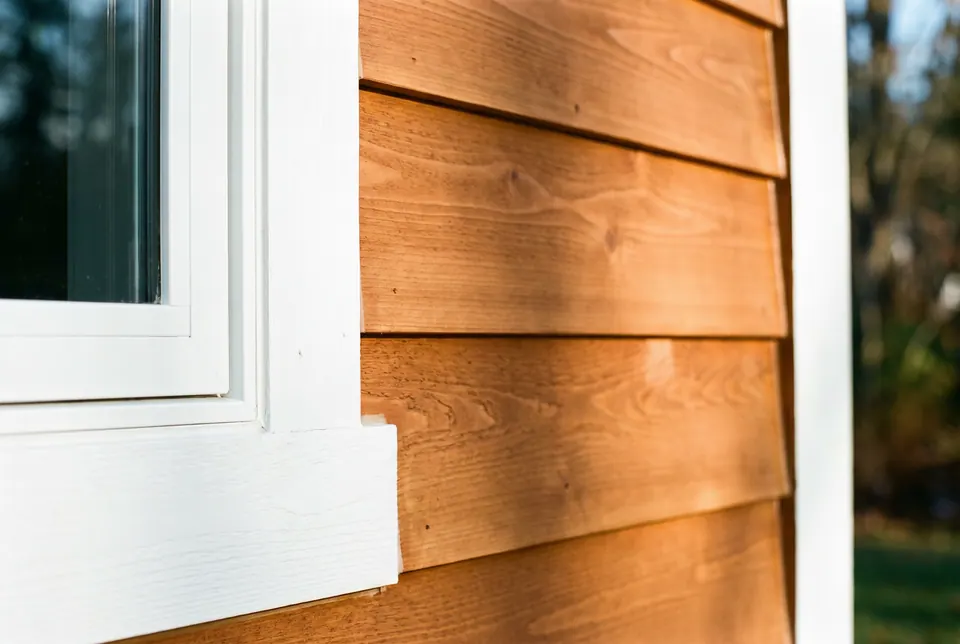
Cedar lap, hardboard, LP SmartSide and vinyl: what we see around here
The northwest metro has four kinds of siding in any given cul-de-sac, and each one fails in its own way. Cedar lap and cedar shake, common on 1970s to 1990s homes in Medina, Plymouth and the lake lots around Buffalo and Greenfield, is durable but splits at the nails, cups when it dries out and takes on water at any unsealed end. It wants stain or paint on a regular cadence. Hardboard (often called Masonite) from the same era swells at the bottom edge, especially on north walls and at the base of a wall near grade, and once the paint skin breaks the board soaks up water fast. LP SmartSide, on most homes built since the late 1990s in Rogers, St. Michael, Albertville, Otsego and Maple Grove, is an engineered wood product that holds up well as long as the factory finish or a paint job keeps the edges sealed. Vinyl does not rot, but it cracks in cold weather, gets holes from hail and mower rocks, and fades unevenly so a replacement panel from the same lot number still does not match. We repair all four. We tell you at the walkthrough what kind you have and what it is doing.
- Cedar lap and shake: splits, cupping, water at unsealed ends
- Hardboard: swollen bottom edges, soft spots near grade and under windows
- LP SmartSide: edge swelling where the finish has failed, otherwise sound
- Vinyl: cracks, hail holes, fading that makes patches show
Repair a section or replace the wall
This is the call that matters, and we make it with you at the house instead of defaulting to the bigger job. If the damage is a few split cedar boards, a swollen hardboard run under one window or a cracked vinyl panel, we repair the section. We cut out the bad boards, check the sheathing and housewrap behind them, replace anything soft, and weave new siding into the old courses so the joints stagger properly. Then it gets primed and painted or stained with the rest of the wall. If a whole elevation is failing, usually the north or west wall that takes the weather, replacing that wall is cheaper and cleaner than patching it in ten places. A full replacement of the house comes into the conversation when hardboard is soft on every side, when the siding has been painted so many times the paint is the only thing holding it together, or when you want to change the material. We lay out all three options on the written estimate when more than one makes sense, with the painting cost for each.
Hail damage on siding
Hail comes through Wright and Hennepin counties most summers, and siding takes it as hard as the roof does. Vinyl gets round holes and cracks. Hardboard gets dents that break the paint skin, and the water gets in from there. Cedar gets bruised and split, often on one side of the house where the storm hit. One of our Google reviewers, J. V. E., hired us to stain thirty-year-old redwood siding that had been hail damaged, and wrote that the crew went above and beyond in siding prep so the final project turned out beautifully. That is our approach to hail: assess it honestly, replace what is broken, and prep the rest properly before the finish goes on. We will document the damage for you with photos, but we do not chase storms and we will not tell you what your insurance company is going to pay. That is between you and your adjuster.
Painting or staining the new siding as one job
New siding next to old siding is where a separate siding contractor and a separate painter leave you with a stripe. We do both, so the sequence is set up for the finish from the start. Replacement boards go up primed, with every cut end sealed on site. Cedar gets back-primed or back-stained before it is nailed so it does not cup. Then the whole wall, old and new, gets the same prep and the same two finish coats, sprayed and back-brushed on lap siding so the coating gets into the laps, brushed on the trim. For stained cedar we blend the color on a sample board first, because fresh cedar and twenty-year-old cedar take the same stain differently. The result is a wall that reads as one wall, and you are done with one crew, one schedule and one final walkthrough. Our exterior painting page covers the finish side in detail, and our staining and sealing page covers cedar specifically.
When we would talk you out of it
- Vinyl siding that is faded but sound. Replacing it for color alone is a big spend. We would suggest a wash and, if the color still bothers you, a vinyl-safe paint on the sunny walls.
- Stucco. It is common on 1990s and 2000s homes in Plymouth and Maple Grove, and it needs a stucco contractor for repairs. We can paint sound stucco, but we do not patch it.
- A few cracked boards on an otherwise healthy wall when you are hoping to be talked into a full replacement. We will repair the boards and paint the wall, and you will keep the difference.
What you get
- Repair, single-wall replacement and full replacement laid out side by side when more than one makes sense
- Sheathing and housewrap checked and fixed behind every board we remove
- New boards woven into the existing courses with staggered joints, not stacked
- Replacement stock primed on all sides and cut ends sealed on site
- Painting or staining of old and new siding as one finish, one crew, one walkthrough
- Trim, fascia and soffit rot handled on the same visit under the same license
How it goes
Walkthrough and material read
We identify what siding you have, probe the soft spots, check behind any loose boards and photograph the damage. You get our honest read on repair versus replacement.
Written estimate with options
Repair, wall replacement or full replacement, each with its painting or staining cost, so you can compare on paper. Trim and fascia repairs are itemized on the same sheet.
Remove, repair the wall, reside
Bad boards come off, sheathing and housewrap get repaired, flashing is set at windows and doors, and new siding goes up with sealed ends and staggered joints.
Prep, finish coats and walkthrough
The whole wall gets washed, caulked and primed as needed, then two finish coats of paint or stain, sprayed and back-brushed. We walk the house with you at the end.
What does siding repair or replacement cost in the northwest metro?
Siding is priced by the square foot for replacement and by the piece for repair, and the material you choose sets the baseline. Vinyl and LP SmartSide sit at one end; cedar at the other, with hardboard rarely installed new anymore. From there the number moves with how much of the house is involved, how tall it is, how many windows and corners the crew has to work around, and what we find behind the old boards. A wall with sound sheathing goes fast. A wall with rotten sheathing or missing housewrap takes another day and more material. Finish is the other half. Painting new siding adds less than most people expect because we are already set up on the wall; staining cedar takes more coats and more care. We write all of it out on the estimate so you can see the carpentry, the material and the finish as separate lines.
- Siding material: vinyl, LP SmartSide, hardboard or cedar
- Square footage being replaced, or number of boards being repaired
- Stories, roof pitches over the wall and staging needed
- Number of windows, doors, corners and penetrations to flash and trim
- Condition of the sheathing and housewrap under the old siding
- Paint or stain finish on the new siding, and whether the rest of the house is being painted at the same time
From the reviewsWhat customers say about this work
★★★★★Cedar Tone did an excellent job painting both our home’s interior and exterior. They went above and beyond by both repairing and staining the exterior siding. We’ve used them twice and would highly recommend them.
★★★★★We have an old wooden house and they used good judgement and did a great job on the repairs they did on the siding as well as the actual painting. When they were done, it looked like a new house! They were responsive to our requests, were polite and unobstrusive on the job and we are very satisfied with the work they did.
Questions we get on the phoneStraight answers.
Can you repair just part of my siding, or does it all have to be replaced?
In most cases we can repair a section. A few split cedar boards, a swollen run of hardboard under a window or a cracked vinyl panel are all repairs, not replacements. We cut out the bad boards, fix anything behind them and weave in new siding. Replacement makes sense when a whole wall is failing or the material is soft everywhere. We give you our honest read at the walkthrough and, when both options are reasonable, put both on the estimate with the painting cost for each so you can compare them on paper.
Will the new siding match the old siding?
Painted or stained siding will match, because we finish the whole wall together once the repair is in. Old and new boards get the same prep and the same two coats, so the repair disappears. Vinyl is the hard one. Even a panel from the same manufacturer will not match twenty years of fading, which is one reason we suggest replacing a full wall of vinyl rather than a patch on a sunny elevation. For stained cedar we blend the stain on a sample so fresh wood reads like the weathered boards next to it.
Is LP SmartSide better than cedar or vinyl in Minnesota?
Each one has a place. LP SmartSide is an engineered wood product that holds paint well, takes hail better than vinyl, and costs less than cedar, which is why most homes built since the late 1990s in Rogers, St. Michael and Albertville have it. Cedar looks like nothing else and can be stained, but it wants maintenance on a regular cadence. Vinyl is the lowest cost and never needs paint, but it cracks in the cold and cannot be repaired invisibly. We install all three and will tell you which fits your house and your budget.
My siding was hit by hail. Do you work with insurance?
We document the damage with photos and write a clear, itemized estimate that you can hand to your adjuster, and we do the repair or replacement once you decide how to proceed. We do not chase storms, we do not file claims for you, and we will not tell you what your insurer is going to approve, because we do not know. The estimate covers what the siding needs to be right again. What your policy pays toward it is a conversation between you and your insurance company.
Can you replace the siding and paint the house in the same project?
Yes, and that is the whole point of being a painter with a contractor's license. We replace the boards, fix the trim and fascia that are usually rotten in the same places, and then paint or stain the entire house as one finish. One estimate, one crew, one schedule. It avoids the stripe you get when a siding contractor leaves and a painter arrives a month later, and it means the new boards are primed and sealed the way a painter needs them to be before they ever go up.
Related
Where we do this work
Siding from our shop in Rockford across Greenfield, Delano, Corcoran, Buffalo, Medina, Rogers, St. Michael and Albertville, and the rest of the northwest metro. See the full service area.