
Doors and drawers off site, boxes on site
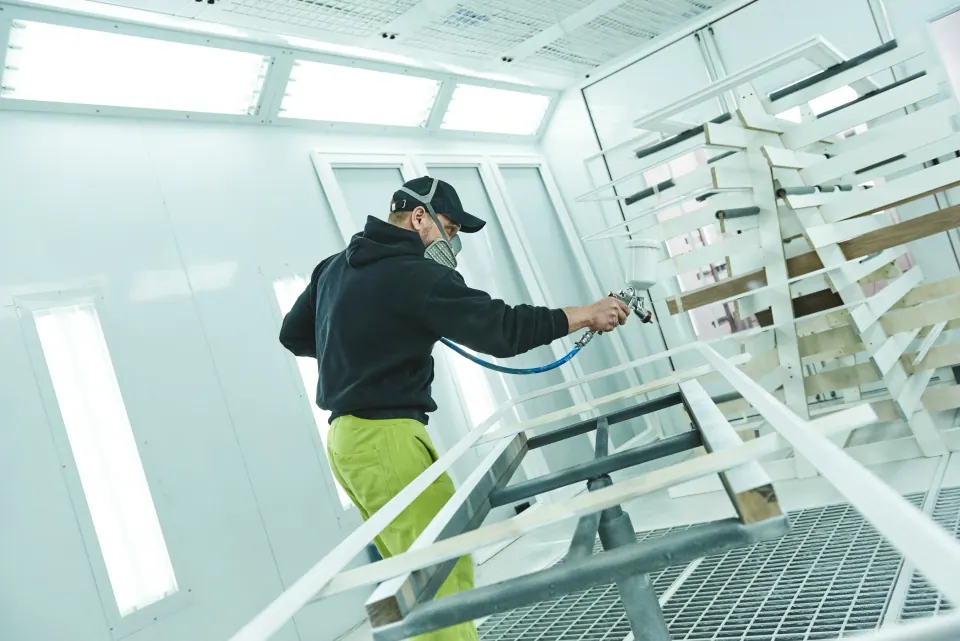
The finish on a cabinet door is the part you see and touch every day, so that is where we spend the most care. Every door and drawer front gets labeled by position, the hinges and pulls come off, and the pieces go to our spray booth. In the booth we can lay doors flat, spray both faces with a fine-finish tip, and let them cure in clean air between coats, which is how you get a finish that looks like it came from a factory rather than a brush. The photo on this page is our booth in use on white enamel trim. Meanwhile the boxes, face frames and end panels are done in your kitchen. We mask the countertops, floors, appliances and the openings to the rest of the house, then spray or brush the frames depending on the layout. The kitchen is usable in the evenings, with the doors off, for the week or so the job takes. Doors go back on with adjusted hinges, and new pulls go on last if you are changing them.
- Every door and drawer labeled and returned to its original opening
- Doors sprayed flat in our booth, both faces, cured between coats
- Boxes and face frames masked and finished in your kitchen
- Kitchen usable each evening with the doors off
Degrease, scuff, bond, two coats: the part you cannot skip
Cabinets fail when someone paints over years of cooking grease and a factory clear coat that was never meant to take paint. So the order matters. Every piece gets degreased with a cleaner that cuts kitchen film, including the tops of doors near the range hood where it builds up thickest. Then we scuff sand every surface to knock the gloss off the old finish and give the primer something to grab. Nail holes, dings and old hardware holes get filled and sanded. Next comes a bonding primer, which is the step that makes the difference between a finish that chips at the corners in a year and one that holds up to a decade of kids and dishwashers. Two coats of waterborne enamel finish it. Waterborne enamel levels out like the old oil trim paints did, dries hard, and does not yellow the way oil does on white and off-white colors. Between coats we sand lightly and wipe with a tack cloth so nothing gets trapped in the finish.
Oak grain honesty
Most of the cabinets we paint in the northwest metro are honey oak, and oak has an open grain with deep pores. Primer and enamel flow into those pores and follow them, so a painted oak door still reads as oak when the light hits it from the side. Some people like that. It looks like painted wood, because it is. If you want a dead-smooth surface that reads like new maple or MDF doors, the grain has to be filled with a grain filler or a high-build primer, sanded flat, and then primed again before the enamel. That is real labor on every door and drawer, and it is its own line on the estimate. We will show you a sample of both on one of your own doors before you decide. What we will not do is spray oak with a standard primer and tell you the grain will disappear. Maple, birch and painted MDF do not have this issue and go straight to bonding primer.
- Oak: grain shows through unless filled, a separate step we quote
- Maple, birch, MDF: smooth after bonding primer
- Sample door finished both ways before you commit
Built-ins, interior doors, railings and trim in the same enamel
Cabinet enamel is the same product and the same method we use on everything else in the house that gets handled. Fireplace built-ins and bookcases get the same degrease, scuff, prime and two coats, sprayed where we can mask the room and brushed where we cannot. Interior doors come off the hinges and go to the booth with the cabinet doors, which is the only way to get a sprayed finish on both faces without runs. Stair railings, spindles and newel posts are brushed in place because of the shapes. And oak trim, which is the most common request after cabinets themselves, gets scuffed, primed and enameled in place, with the walls cut in afterward so the line between trim and wall is clean. A lot of houses here do trim and cabinets in the same winter, since the crew and the masking are already there. Our own new-construction finish work includes painted built-ins, mudroom lockers and laundry cabinets in enamel, and those photos are on the our-work page.
When we would talk you out of it
- Cabinet boxes that are swollen, delaminating or falling apart at the joints. Enamel does not fix structure. That kitchen wants new cabinets, and we can talk about that on the remodeling side.
- Thermofoil or laminate doors that are peeling. Paint will not bond to a finish that is already letting go. Replacing the doors and painting the boxes to match is usually the better move.
- A kitchen you plan to gut within two years. Painting it is money you will not get back. A deep clean and new pulls will carry it until the remodel.
What you get
- Doors and drawers sprayed off site in a booth, not in your kitchen
- Degrease, scuff sand and bonding primer under every coat of enamel
- Waterborne enamel that dries hard and does not yellow on whites
- Straight talk about oak grain, with a sample door finished both ways
- Same method on built-ins, interior doors and oak trim
- Kitchen usable in the evenings for the length of the job
How it goes
Walkthrough, sample and written estimate
We look at the cabinets, check the doors and boxes for damage, talk color and sheen, and leave a written estimate. On oak we finish a sample door so you can see the grain question in person.
Doors off, kitchen masked
Doors and drawer fronts are labeled and pulled, hardware bagged, and the kitchen masked at the counters, floors, appliances and openings. Doors go to our booth.
Clean, scuff, prime, enamel
Every piece is degreased, scuff sanded, filled, bonding primed and finished with two coats of waterborne enamel, with a light sand between coats.
Reinstall and walkthrough
Doors go back on with hinges adjusted, new pulls installed if you chose them, masking removed, and a walkthrough with you under the kitchen lights.
What does cabinet painting cost in the northwest metro?
The number is driven mostly by how many doors and drawer fronts there are, since each one is handled a dozen times between the first cleaning and the last coat. A galley kitchen with twenty doors is a very different job from an open kitchen with an island, a pantry wall and forty-plus pieces. Wood species is the next factor: oak that you want grain-filled adds real hours per door, while maple and painted MDF go straight to primer. Condition matters too. Heavy grease, water damage at the sink base, and old hardware holes that need filling all add prep. Then the extras: interior doors, built-ins and trim done in the same visit, glass doors that need masking, and a color change from a dark stain to white, which can need an extra coat. The estimate lists all of it, and the walkthrough is how we get it right.
- Number of doors, drawer fronts and end panels
- Wood species and whether oak grain is being filled
- Condition: grease buildup, water damage, hardware holes to fill
- Color: dark stain to white can need an additional coat
- Built-ins, interior doors, railings and trim done in the same visit
- New hardware installation and hinge adjustment
From the reviewsWhat customers say about this work
★★★★★Cedar Tone Painting was recommended to me by a potential client. They quickly got back to me and came out for an estimate at a time that suited my needs. The estimate that I received was complete and thorough. Expectations and completion time frame were clearly conveyed to me and there were no surprises. Quality of work and willingness to complete the project on my terms was important to me. I would certainly use Cedar Tone Painting again in the future for any painting projects that I have. Their willingness to help me move a few pieces of furniture was a pleasant surprise and contributed to a great experience. I enjoyed the friendliness and professionalism of the crew. Thank you Cedar Tone Painting!
★★★★★Cedar Tone did an excellent job painting both our home’s interior and exterior. They went above and beyond by both repairing and staining the exterior siding. We’ve used them twice and would highly recommend them.
Questions we get on the phoneStraight answers.
Is it worth painting oak cabinets instead of replacing them?
Usually yes, if the boxes and doors are solid. Oak cabinets from the 1990s and 2000s are often better built than what replaces them, and a sprayed enamel finish updates the kitchen for a fraction of a new set. The trade is that oak grain shows through paint unless it is filled, which adds labor. If the boxes are swollen or falling apart, painting is not the answer.
Will the wood grain show through painted oak cabinets?
Yes, unless we fill it. Oak has open pores, and primer and enamel follow them, so a painted oak door still reads as wood from the side. Filling the grain with a grain filler or high-build primer and sanding it flat gives a smooth finish, but it is extra work on every piece and a separate line on the estimate. We finish a sample door both ways so you can choose.
Do you spray or brush cabinets?
Both, on purpose. Doors and drawer fronts are sprayed in our booth, laid flat and cured between coats, which gives the smoothest finish. Boxes and face frames are sprayed or brushed in your kitchen behind masking depending on the layout. Railings and some trim are brushed because of their shape. Waterborne enamel levels well either way.
How long are the cabinets out of service?
Figure about a week for a typical kitchen, sometimes a little more with grain filling or a lot of pieces. The boxes are done in a couple of days and the kitchen is usable in the evenings with the doors off. Doors cure in the booth and go back on at the end. We ask you to go easy on the finish for a couple of weeks while the enamel fully hardens.
Can you paint just the trim and doors, not the cabinets?
Yes. Oak trim to white is one of our most common winter jobs on its own. The trim is degreased, scuff sanded, bonding primed and finished with two coats of waterborne enamel in place, and interior doors come off the hinges to be sprayed in the booth. The walls get cut in afterward so the line is clean.
Related
Where we do this work
Cabinet painting from our shop in Rockford across Greenfield, Delano, Corcoran, Buffalo, Medina, Rogers, St. Michael and Albertville, and the rest of the northwest metro. See the full service area.