
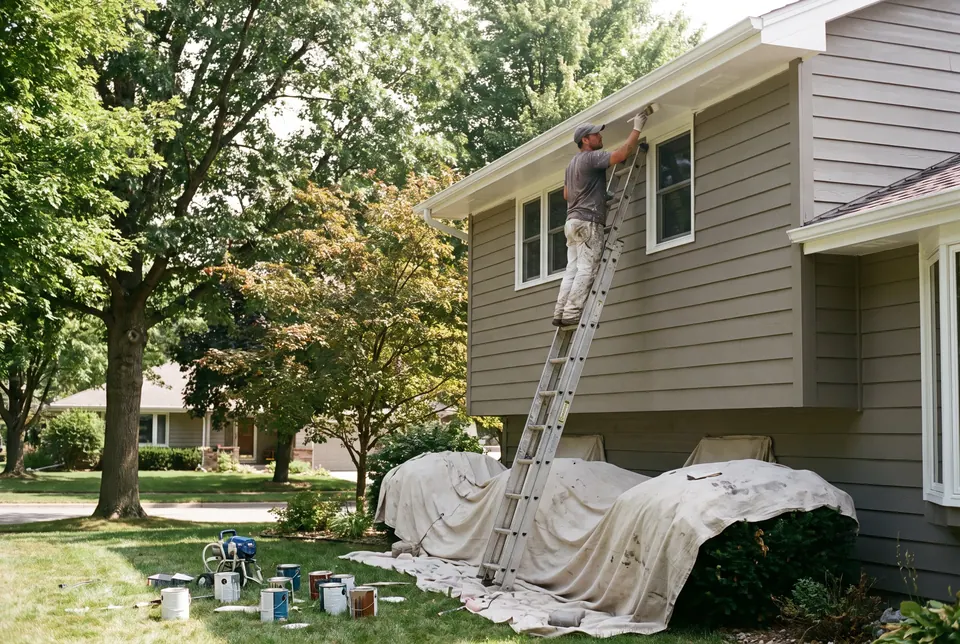
What a Cedar Tone exterior repaint includes
Every exterior job starts with a walkthrough. We go around the house with you, poke at the trim with an awl, and write an estimate that lists the painting and every repair as its own line item, so you can see what is paint and what is carpentry. On the first day the crew washes the house to get pollen, chalk and mildew off the siding. Then we scrape anything loose, sand the edges so the old paint feathers into the bare wood, and replace whatever is rotten: fascia, window sills, corner boards, a soffit panel, a length of lap siding. That repair work is done by our own crew under our contractor license, with primed wood or matching engineered trim, not a smear of filler. Gaps get caulked, bare wood gets spot primed, and the whole house gets two finish coats of premium exterior paint. On siding we spray and then back-brush, which pushes the paint into the grain and the lap joints instead of leaving it sitting on the surface. Trim, doors and shutters are brushed. We clean up every day, pull the masking, and walk the house with you at the end. Reviews on Google mention the things we care about most: masking that protects the roof and windows, clean cut lines, matched colors, and a crew that shows up when it said it would.
- Written estimate with repairs listed separately from paint
- Pressure wash, scrape, sand and feather every edge
- Rotten fascia, sills, corner boards and siding replaced by our licensed crew
- Caulk, spot prime and two finish coats, sprayed and back-brushed on siding
- Trim, doors, shutters and garage doors brushed
- Daily cleanup and a final walkthrough with you
Why exterior paint fails in Minnesota, and where to look first
Paint on a Minnesota house does not wear evenly, and knowing where it fails tells you what to check before you call anyone. The south and west walls take the full afternoon sun from May through September. That is where the color fades first and where the top coat chalks and thins, so a house that looks fine from the street can be down to primer on the back. Freeze and thaw does the rest. Water gets behind a hairline crack in the caulk at a window casing, freezes, and pries the paint off in flakes, which is why most peeling starts at joints and end grain rather than in the middle of a board. Ice dams push meltwater under the shingles and down behind the fascia and soffit, and by the third winter the fascia is soft. The north side rarely dries out under the trees, so it grows mildew and green algae that has to be washed off before paint will stick. And the west metro gets its share of hail. A hail storm leaves dents and cracked paint on hardboard and cedar, chips on painted steel doors, and can crack fiber cement corners, so we look for that during the walkthrough and photograph it in case your insurance is involved.
- South and west walls: sun fade, chalking, thin top coat
- Joints, casings and end grain: freeze-thaw peeling
- Fascia and soffit behind ice dams: rot
- North side under trees: mildew and algae
- West-metro hail: dents, cracked paint, chipped steel doors
The siding we see most in the northwest metro
The northwest metro was built in waves, and each wave used a different skin. Houses from the 1970s through the early 1990s in Plymouth, Maple Grove, Medina and the older parts of Buffalo and Delano tend to wear cedar or hardboard lap siding. Cedar takes paint or stain well if it is dry and clean, but it also splits and cups, and old hardboard swells at the bottom edge where water sits. Those bottom edges and the boards below windows are the ones we end up replacing. Subdivisions from the late 1990s and 2000s in Rogers, St. Michael, Albertville, Otsego and Corcoran used a lot of LP SmartSide and similar engineered lap. It holds paint for a long time, but it has to be recoated before the factory finish wears through at the joints, because once water reaches the substrate the board swells and there is no fixing it with paint. Then there is painted vinyl. We paint vinyl siding more than you might expect, sometimes because a previous owner painted it and the finish is uneven. It works with a vinyl-safe color no darker than the original, so the siding does not absorb heat and warp. And on older cedar homes the question is often paint or stain, which we cover on the staining and sealing page.
Season and scheduling: May to mid-October, booked in order
Exterior paint needs the surface and the overnight air above about 50 degrees to cure the way the manufacturer intends. In this part of Minnesota that gives us a window from early May to roughly the middle of October, with the shoulder weeks depending on the forecast. Because the season is short, we book it in order. Spring calls get spring and early summer dates, and by August the calendar is usually into September. If you call in March, you are near the front of the line and can pick your month. If you call in July, we will give you an honest date and tell you if it is looking like next year. Rain days push everything back a day, and we would rather tell you that up front than paint wet wood. Repairs that turn up during scraping get added to the estimate before we do them, and we can do the carpentry side in the shoulder months when it is too cold to paint, then come back for the coats. Interior painting, cabinets and trim fill our winter, so if the exterior has to wait, we can still get the inside done first.
When we would talk you out of it
- Siding that is swollen, delaminated or rotten across whole walls. Paint will not hold it together. We would quote a siding replacement instead, and since we are licensed for that work it is one crew and one estimate.
- A house that was painted within the last two or three years and just looks dirty. A wash and a few spot touch-ups are a better spend than a full repaint, and we will say so at the walkthrough.
- Vinyl siding you want painted a much darker color. Dark paint on vinyl absorbs heat and the panels warp. We will show you the vinyl-safe range for the color you have in mind, or talk about replacing the siding.
What you get
- Rot and trim repairs by our own crew under a Minnesota contractor license, no second contractor
- Every repair listed as a line item so you know what is paint and what is carpentry
- Wash, scrape, sand, caulk and prime before the first finish coat
- Two coats sprayed and back-brushed on siding, brushed on trim and doors
- Masking that protects roofing, windows, brick and plantings
- Daily cleanup and a walkthrough with you before we leave
How it goes
Walkthrough and written estimate
We come out, go around the house with you, probe the trim and sills, and leave a written estimate that separates paint from repairs. Color help is part of it if you want it.
Wash, scrape, sand and repair
The house gets washed, loose paint scraped and feathered, and rotten fascia, sills, corner boards or siding replaced by our crew with primed wood or matching engineered trim.
Caulk, prime and two coats
Joints caulked, bare wood spot primed, then two finish coats: sprayed and back-brushed on siding, brushed on trim, doors, shutters and garage doors.
Cleanup and final walkthrough
Masking comes off, the yard gets picked up, and we walk every side of the house with you. Anything you point at gets touched up before the truck leaves.
What does exterior painting cost in the northwest metro?
Every exterior estimate we write is built from the same handful of things, and we itemize them so you can see where the number comes from. The size and height of the house sets the base. A walkout two-story with a steep grade on the back takes more ladder and staging time than a rambler. Condition is the next lever: a house that needs a wash and two coats is a very different job from one that needs heavy scraping, a full prime coat and a dozen boards replaced. Repairs are always their own line items, so the painting price does not hide carpentry. Siding type matters, since cedar and hardboard take more prep and more paint than engineered lap, and a stain job is priced differently from paint. Trim count, number of colors, and whether shutters, garage doors and a deck are included all add hours. We do not publish numbers because two houses on the same street can be far apart, but the estimate is written, and the walkthrough costs you nothing.
- Square footage, number of stories and how much of the house needs staging
- Condition: how much scraping, sanding and priming the old finish needs
- Rot and trim repairs, quoted as separate line items
- Siding material: cedar, hardboard, engineered lap, fiber cement or vinyl
- Trim, shutters, doors, garage doors and railings included
- Number of colors and whether the body color is changing
- Access: grade, plantings, decks and roof lines the crew has to work around
From the reviewsWhat customers say about this work
★★★★★We hired Cedar Tone Properties & Painting to paint the exterior of our house and to repair some roofing on the peak of our house (which was done incorrectly by a different roofing company). CTP did excellent work on both projects. The painting crew was meticulous and accommodating. They made sure we were completely happy with the final result. The roofing crew matched the shingles perfectly and finished the roof peak correctly. Our house looks wonderful! We are extremely satisfied with Cedar Tone and recommend them for your painting or roofing needs.
★★★★★Cedar Tone did an excellent job painting both our home’s interior and exterior. They went above and beyond by both repairing and staining the exterior siding. We’ve used them twice and would highly recommend them.
Questions we get on the phoneStraight answers.
When is the right time of year to paint a house exterior in Minnesota?
May through mid-October. Exterior paint needs the surface and the overnight air above about 50 degrees, and in the northwest metro that window opens in early May and closes when the October nights turn cold. June through September is the safest stretch. Because the season is short, we book jobs in the order the calls come in, so a call in late winter gets you a choice of months.
How long does exterior paint last on a house in Minnesota?
Most houses here need repainting in the range of seven to ten years, and the south and west walls go first. Cedar and hardboard on the sunny sides can need attention sooner. Engineered lap siding holds paint longer but must be recoated before the finish wears through at the joints. Good prep and two full coats are what push a paint job toward the long end of that range.
Do you fix rotten wood before painting?
Yes, and our own crew does it. Cedar Tone holds a Minnesota residential building contractor license, so we replace rotten fascia, sills, corner boards, soffit panels and siding boards as part of the paint job instead of sending you to find a carpenter. Repairs are listed as separate line items on the estimate, and we photograph anything we find during scraping before we replace it.
Do you spray or brush exterior paint?
Both. On siding we spray to get an even film quickly and then back-brush every pass, which works the paint into the grain and lap joints so it bonds instead of bridging. Trim, doors, shutters and garage doors are brushed. Spraying alone is fast but leaves paint sitting on top of the wood, and that is the job that peels in a few winters.
Can vinyl siding be painted?
Yes, with the right paint and the right color. Vinyl can be painted with an exterior acrylic made for it, in a shade no darker than the original panel color. Darker colors absorb heat and the siding warps. We have repainted vinyl homes where an earlier paint job was uneven, and the fix was a wash, a light sand and two coats in a vinyl-safe color.
Related
Where we do this work
Exterior painting from our shop in Rockford across Greenfield, Delano, Corcoran, Buffalo, Medina, Rogers, St. Michael and Albertville, and the rest of the northwest metro. See the full service area.