
Cedar Tone · September 27, 2026 · Staining and sealing
Should You Paint or Stain Cedar Siding?
The short answer: If the cedar is bare or wears a semi-transparent stain now, stay with stain. If it already carries solid stain or paint, it is a painted house and the honest path is to keep it that way. Semi-transparent shows the grain and needs recoating more often; solid stain and paint hide the wood and last longer per coat, but they build a film that eventually peels and has to be scraped.
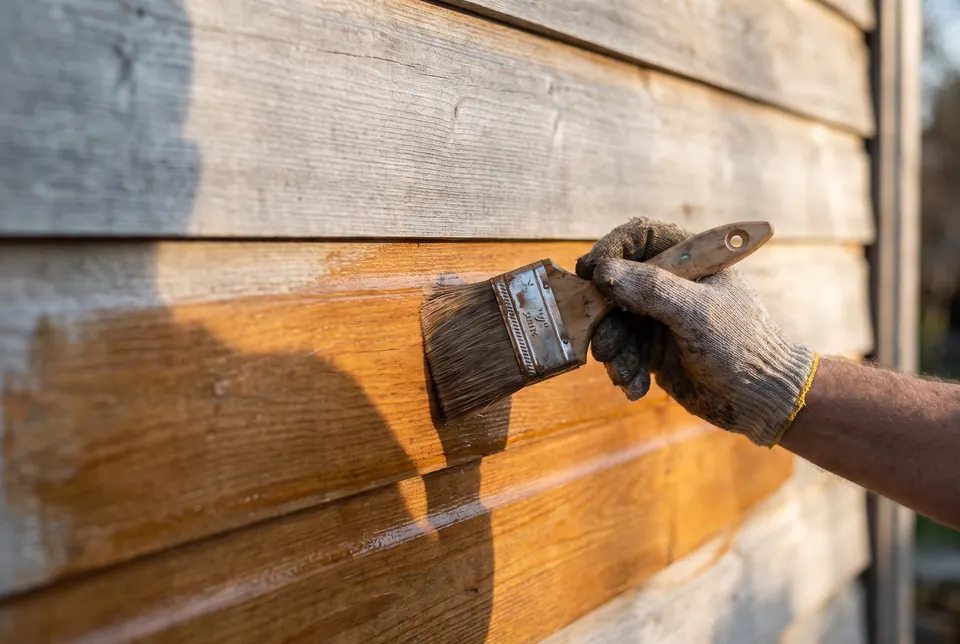
The short answer: If the cedar is bare or wears a semi-transparent stain now, stay with stain. If it already carries solid stain or paint, it is a painted house and the honest path is to keep it that way. Semi-transparent shows the grain and needs recoating more often; solid stain and paint hide the wood and last longer per coat, but they build a film that eventually peels and has to be scraped.
Cedar siding is what our name comes from, and it is a lot of what we work on in the wooded acreage neighborhoods around Rockford, Greenfield and Medina. Here is how we talk about it at the kitchen table.
What is already on the house decides
Before anyone picks a color, look at what the cedar is wearing now. The three choices are not interchangeable, and moving between them costs a lot more than staying put.
Bare or gray-weathered cedar has never had a film on it. It can take anything, but it takes semi-transparent stain most readily, because the wood is open and the stain soaks in.
Semi-transparent stain looks like colored wood. You can see the grain and the knots. Water still darkens the surface. Recoating it with more semi-transparent is a wash-and-stain job.
Solid stain looks like thin paint. The grain texture shows, the grain color does not. It has built a film, even a thin one, and that film is what you are maintaining from here on.
Paint is a full film with a primer under it. It is the most opaque, the longest-lasting per coat on cedar, and the most permanent decision.
The rule we go by: you can always go more opaque. Semi-transparent can go to solid, solid can go to paint. Going the other way means removing the film from every board, and we cover below why that is almost never the right call.
Semi-transparent stain
This is the finish people picture when they picture cedar. It penetrates rather than coats, so it does not peel. It fades and wears thin instead, which means the failure mode is gradual and the fix is another coat, not scraping.
The honest part is the cadence. On a Minnesota house, the south and west walls take direct sun for the long days and reflected sun off snow in winter, and semi-transparent on those walls is usually ready for another coat in three to five years. A wall facing a lake, with sun coming off the water, can be sooner. North and shaded walls go much longer, often twice as long. That means a house in semi-transparent is not restained all at once every few years; it is restained wall by wall on a rolling schedule, sunny sides first, and the coat on the north side may skip a cycle.
Prep is where a semi-transparent job succeeds or fails, because there is no film to hide anything. Every board shows.
Solid stain
Solid stain is the middle path, and it is what a lot of the cedar houses in the northwest metro already wear whether the owners know it or not. It carries enough pigment to hide the grain color and most surface variation, it lets the texture of the cedar show through, and it holds up in a Minnesota sun cycle for something closer to a paint schedule, often seven to ten years by what we see. Those are ranges, not promises, and the south wall sets the pace.
Because it is a film, it eventually peels, and when it does, the peeled areas get scraped and feathered before the next coat, the same as paint. It is also the way to get a dark modern color on cedar without committing fully to paint, which is a lot of what people are asking for right now.
Solid stain over old semi-transparent is a common and sensible move when the semi-transparent has worn unevenly and the owner is tired of the rolling schedule.
Paint
Paint on cedar means a stain-blocking primer and two finish coats. Cedar tannins bleed through ordinary primer and show as brown streaks in a light color, so the primer choice is not optional. With the right primer and a premium exterior paint, sprayed and back-brushed into the grain the way we do siding, painted cedar lasts as long as any painted siding and longer than most.
The trade-off is finality. Painted cedar is a painted house. You will never see the wood again without stripping every board, and a painted cedar house with peeling on the south side looks exactly like a peeling hardboard house. If the cedar is already painted, keep it painted and put the money into prep and a good product. If it is not, think hard before you start.
Prep on cedar, no matter which finish
Cedar rewards prep and punishes skipping it, because it is soft, it moves with moisture, and it grows mildew on any shaded wall in this climate.
Our sequence:
- Wash. Remove mildew, pollen, chalk from old solid stain, and the gray layer of weathered fibers on bare cedar. On semi-transparent jobs we use a cleaner and, where the wood has grayed, a brightener that brings the color back.
- Dry. Cedar has to be dry through, not on the surface. We put a moisture meter on it and want a reading in the mid-teens or below before stain or primer goes on. After a wash, that is at least a day of sun, longer on a north wall under trees.
- Probe. An awl into the bottom of every sill, the bottom foot of the corner boards, the fascia and any board near grade. Cedar rots from the bottom up, and soft boards get replaced with cedar of the same profile before any finish goes on. Cedar Tone holds a Minnesota residential building contractor license, so rot and trim repair happens in the same visit by the same crew.
- Scrape and sand any peeling film on solid-stain or painted cedar, and feather the edges.
- Apply board by board. Stain is sprayed and back-brushed, or brushed, along the full length of each board, keeping a wet edge so the overlaps do not flash. Stopping in the middle of a board and coming back an hour later shows on cedar. It does not show much on paint. It shows a lot on semi-transparent.
- Watch the weather. The same temperature and dew point rules as paint: siding above about 50 F, no rain for a day after, nights above the dew point.
When we’d talk you out of stripping
Every year someone with a painted or solid-stained cedar house asks about stripping it back to the wood so they can go to semi-transparent. We understand the appeal, and we usually say no.
Stripping a whole house means chemical strippers or aggressive sanding on every board, sometimes both. It is slow, it is expensive in labor, it never gets every board fully clean, and the sanding takes the surface off cedar that has already lost thickness to weathering. The wood under a thirty-year-old film is rarely the wood people are picturing. What comes out is a house that took weeks of work and still needs a solid stain to look even.
Where stripping does make sense: a small area like a gable or an entry, a house where the film has already failed across most of the siding and has to be scraped anyway, or new cedar that got the wrong product on it recently. Otherwise, the better paths are a fresh solid stain in the color you want, or a repaint done properly, and both of them are covered on our staining and sealing page.
Cedar in the northwest metro
A lot of the cedar we work on sits on wooded lots with heavy shade on the north side and open sun on the south. That combination is the whole cedar problem in one house: mildew and slow drying on one wall, fade and checking on the other. It is why we sequence a cedar job around the north wall’s dry time, why we treat mildew instead of staining over it, and why the recoat schedule on one house can be two different numbers.
If your cedar is due and you are not sure what is on it now, send a couple of photos through the contact page, one close-up in the sun and one of the north side, and we’ll tell you which finish it is and what we’d do next.
Want us to look at your house?
Text a few photos and tell us what you are after. We reply with a written estimate.
Related questionsStraight answers.
Is it better to stain or paint cedar siding?
It depends on what is on it now. Bare or semi-transparent cedar should stay in stain, which soaks in and never peels. Cedar that already has solid stain or paint has a film on it, and going back to a penetrating stain means stripping the whole house, which we rarely recommend. Stain if you can, paint if you already have.
How often does cedar siding need to be restained?
Semi-transparent stain on the south and west walls of a Minnesota house is usually ready again in three to five years, sooner on a lake side with reflected sun. North and shaded walls go longer. Solid stain is closer to a paint schedule, often seven to ten years. Those are ranges from what we see, not promises, and sun exposure decides where your house falls.
Can you paint over stained cedar siding?
Yes, over solid stain with a wash, a scuff and a good primer. Over semi-transparent stain, the cedar needs to be clean, dry and primed with a stain-blocking primer, because cedar tannins bleed through ordinary primer and show as brown streaks in a light color. Once cedar is painted it stays painted, so make that call once.
How do you prep cedar siding before staining?
Wash it to remove mildew and gray weathered fibers, treat any tannin or mildew staining, let it dry until a moisture meter reads in the mid-teens or below, then replace any soft boards. Stain goes on board by board, sprayed and back-brushed or brushed, keeping a wet edge along the full length so the laps do not show.
Should I strip the paint off my cedar siding to stain it?
Usually no. Stripping a whole house of paint or solid stain means chemical strippers or heavy sanding on every board, and weathered cedar under the film is rarely the wood you are imagining. The exception is a small area, or a house where the film has already failed across most of the siding. Otherwise, repaint or move to a solid stain.