
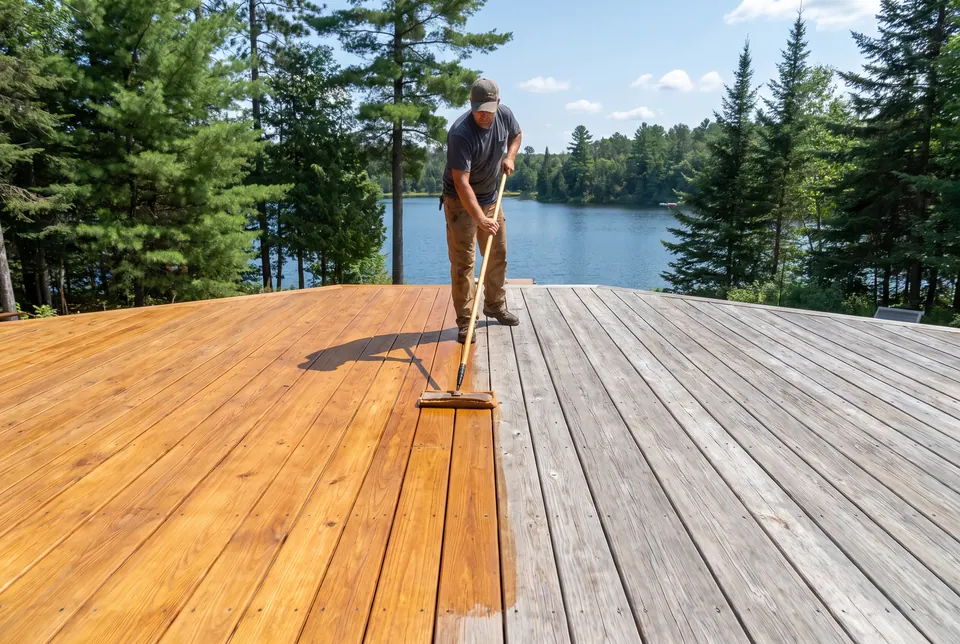
Why horizontal surfaces fail first
Stand on a deck in July and you can feel why. The boards face straight up at the sun for the whole day, so they take more UV than any wall on the house, and UV is what breaks down the finish and grays the wood. Rain and snowmelt sit on a flat board instead of running off, so water soaks in through the cracks, freezes, and opens the grain a little more each winter. Then there is foot traffic, grills, planters and furniture legs, none of which a siding board ever deals with. The railings and spindles on the same deck, which are vertical, often look fine when the floor has gone gray and rough. That is why we treat the two differently. The deck boards get the heaviest prep and the most durable penetrating product we can use, and the railings get a lighter touch, and we tell you the floor will need a coat before the rails do. Stairs and the top rail take the most wear of all and often need the most work.
- Deck boards: full sun, standing water, foot traffic, shortest life
- Railings and spindles: vertical, shed water, last longer
- Stair treads and top rail: most wear, first to need a coat
Stripping failed film stains
The decks we get called about most are the ones somebody coated with a thick film product a few years ago, the kind sold as a deck restoration coating or a solid deck paint. Those products fill the cracks and look great the first summer, then the water gets under the film, freezes, and the coating lifts in sheets, taking the top layer of wood with it. Once a deck has a failing film on it, the only fix is to strip it. We use a chemical stripper made for the job, let it work, and pressure wash at a pressure that lifts the coating without furring the wood. Stubborn spots get a second application or a sander. Then a brightener neutralizes the stripper and brings the wood back to its natural color. It is slow work, and it is the reason a deck with a failed film costs more to restain than a deck that was left to gray. We will tell you before we start if your deck is a strip job, and we will not put a penetrating stain over a film that is still stuck, because it will not soak in.
Oil versus waterborne penetrating stains
Once the wood is clean and dry, the choice is between an oil-based penetrating stain and a waterborne penetrating stain, and both have a place. Oil soaks deepest, brings out the color in cedar, and is forgiving to apply on hot days. It also feeds mildew if the deck is shaded and stays damp, and it needs recoating more often. Waterborne penetrating stains have improved a lot, hold color longer against UV, resist mildew better, and clean up easier, but they are fussier about application temperature and a wet edge, and they can look a little flatter on cedar. We lean toward oil on a cedar deck in full sun and waterborne on a treated deck under trees, but the real answer comes from looking at your deck. Either way it is a penetrating product, not a film, and either way it goes on with a pad applicator and is back-brushed along the boards so it soaks in evenly without puddling in the gaps.
- Oil: deepest penetration, richest color on cedar, shorter cycle, feeds mildew in shade
- Waterborne: better UV and mildew resistance, longer color, fussier to apply
- Both applied by pad and back-brushed, never a film
Annual to three-year cadence, and when to rebuild instead
Here is the part most deck stain ads leave out. A deck floor in the northwest metro needs a coat somewhere between every year and every three years. A cedar deck facing south with no shade is at the short end. A treated deck on the north side of the house under a maple is closer to three. Railings go longer. There is no product that turns that into a ten-year cycle on a horizontal surface in this climate, and a product that claims to is usually a film that will peel. The good news is that a maintenance coat on a deck that was done right is a small job: a wash, a dry day, one coat. Some decks are past that point. Boards that are cupped, splitting through, or soft at the ends, joists that flex, ledger boards pulling away from the house, and railings you would not lean on are structural problems, and stain does not fix structure. Because we are licensed for the carpentry, we can replace a few boards as part of a stain job, or, when it is most of the deck, quote a rebuild. Our deck design and rebuild page shows a full before-and-after we did with composite decking and black railing. Sometimes that is the honest answer.
When we would talk you out of it
- A deck with a thick film coating that is still firmly stuck. Penetrating stain will not soak through it. Either it gets stripped to bare wood, which we will quote, or it gets another coat of the same film with the same problems.
- Boards that are cupped, split through, or soft at the ends, or a frame that flexes. Stain will not hold that together. We would replace the bad boards, or if it is most of the deck, quote a rebuild instead.
- A new cedar or treated deck built this month. New wood needs a few weeks to a few months to weather before it will take stain evenly. We will put you on the calendar for later in the season.
What you get
- Failed film coatings stripped, not stained over
- Cleaner and brightener on every deck so the stain reads true
- Moisture checked before the first coat, no staining wet boards
- Penetrating oil or waterborne stain chosen for your deck's sun and shade
- Bad boards replaced by our own crew under our contractor license
- Straight talk about the recoat cycle and whether the deck is worth staining
How it goes
Walkthrough and written estimate
We check the boards, the frame, the ledger and the railings, figure out whether there is a film to strip, and leave a written estimate that separates staining from any board replacement.
Strip, clean and brighten
Failed film gets stripped chemically and washed off. Every deck then gets a wood cleaner to lift gray fibers and mildew and a brightener to neutralize and restore the color.
Dry, then stain
We wait for the boards to read dry on the meter, then apply a penetrating stain by pad, back-brushed along each board so it soaks in evenly without puddling in the gaps.
Railings, stairs and walkthrough
Railings, spindles and stair treads get their coat, and we walk the deck with you. We note the product used and the recoat cycle so the next visit is a quick one.
What does deck staining cost in the northwest metro?
Deck staining is priced from the walkthrough, and the biggest swing is whether there is a failed film to strip. A gray, never-coated deck that needs cleaner, brightener and stain is the simpler job. A deck under a peeling restoration coating needs stripping first, which can double the prep time. After that it is size, railing length, stairs and the number of levels, since railings and spindles are slow, fiddly work compared to open floor. Product choice moves it a little. Board replacement is always its own line item, done by our crew, so there is no second contractor. And a deck we stained a couple of years ago that just needs a maintenance coat is a much smaller job than a first-time restoration, which is the reason to stay on the cycle. The estimate is written and the walkthrough costs nothing.
- Deck square footage and number of levels
- Whether a failed film coating has to be stripped
- Linear feet of railing, spindle count and stairs
- Condition: never coated, recently stained, or years of neglect
- Oil or waterborne penetrating stain and number of coats
- Board or railing replacement, quoted separately
From the reviewsWhat customers say about this work
★★★★★Cedar Tone did an excellent job painting both our home’s interior and exterior. They went above and beyond by both repairing and staining the exterior siding. We’ve used them twice and would highly recommend them.
★★★★★Cedartone Staff was very responsive when we first contacted them in early spring. They were able to get to our project within a month, and work with us on stain color and type to cover 30-yr old redwood siding that was damaged by hail. They were careful and deliberate, and went above and beyond in siding prep so that the final project turned out beautifully. We liked their work so well that we invited them to return to paint our interior 2-story front entryway. Again, they helped in color selection, and were flexible in painting an added wall not in the original bid. We would definitely use their services again.
Questions we get on the phoneStraight answers.
How often should a deck be stained in Minnesota?
Every year to every three years for the floor, depending on sun and product. A south-facing cedar deck with no shade is at the short end. A treated deck under trees on the north side can go closer to three. Railings last longer than the floor. No penetrating stain stretches that to ten years on a flat board here, and a product that claims to is usually a film that will peel.
Can you stain over an old deck stain?
Over a worn penetrating stain, yes, after a wash and a brightener. Over a film coating that is peeling, no. Penetrating stain cannot soak through a film, so the old coating has to be stripped to bare wood first. We will tell you which kind you have at the walkthrough, and if there is any doubt we test a small area before quoting the job.
Is oil or water-based deck stain better?
Depends on the deck. Oil soaks deeper and brings out cedar's color, but it needs recoating sooner and feeds mildew in shade. Waterborne penetrating stains hold color longer against sun, resist mildew, and clean up easier, but they are fussier to apply. We lean oil on cedar in full sun and waterborne on treated wood under trees. Both are penetrating products, not films.
How long after building a deck can it be stained?
New cedar and treated lumber need time to weather before stain will soak in evenly, usually a few weeks for cedar and a few months for treated wood, which comes wet from the mill. Staining too early leaves a blotchy finish that wears unevenly. If we build your deck, we schedule the first stain for later the same season or the following spring.
When should a deck be rebuilt instead of stained?
When the problem is the wood, not the finish. Boards that are cupped, split through or soft at the ends, joists that flex when you walk, a ledger pulling away from the house, or railings that move are structural, and stain does not fix structure. We can replace a few boards as part of a stain job. When it is most of the deck, we quote a rebuild, which our crew does under our contractor license.
Related
Where we do this work
Deck staining from our shop in Rockford across Greenfield, Delano, Corcoran, Buffalo, Medina, Rogers, St. Michael and Albertville, and the rest of the northwest metro. See the full service area.